|
Welcome to the SAPHA December Newsletter!
As we close out an incredible year at SAPHA, we’re taking a moment to reflect on everything we’ve built together. From expanding our community programs to elevating South Asian public health voices, this year has been full of meaningful progress made possible by people like you.
We invite you to watch our
Year in Review
and celebrate the milestones, stories, and impact we achieved as a community. Thank you for showing up, volunteering, advocating, sharing, and investing in better health for all.
As we look ahead, your support remains essential. If you’re able, please consider
making a donation
to help fuel our work in 2026 and beyond.
Wishing you a joyful and healthy New Year. We can’t wait to see you in 2026!
⬇️
Let’s dive in!
⬇️
|
|
|
✨
Curious about our work?
✨
Come be part of it!
|
|
|
Want to get involved with SAPHA? We’d love to hear from you.
Whether you’re interested in volunteering, joining a committee, lending your expertise, or simply learning more about our work, filling out our interest form is the first step.
Share a bit about your interests and how you’d like to contribute, and
a member of our team will be in touch.
✅
Get involved today:
https://sapha.org/about/apply/
|
|
|
✨ 📣
Join the CARE 2.0 Study
✨
Make Your Voice Count in Health Research!
|
|
|
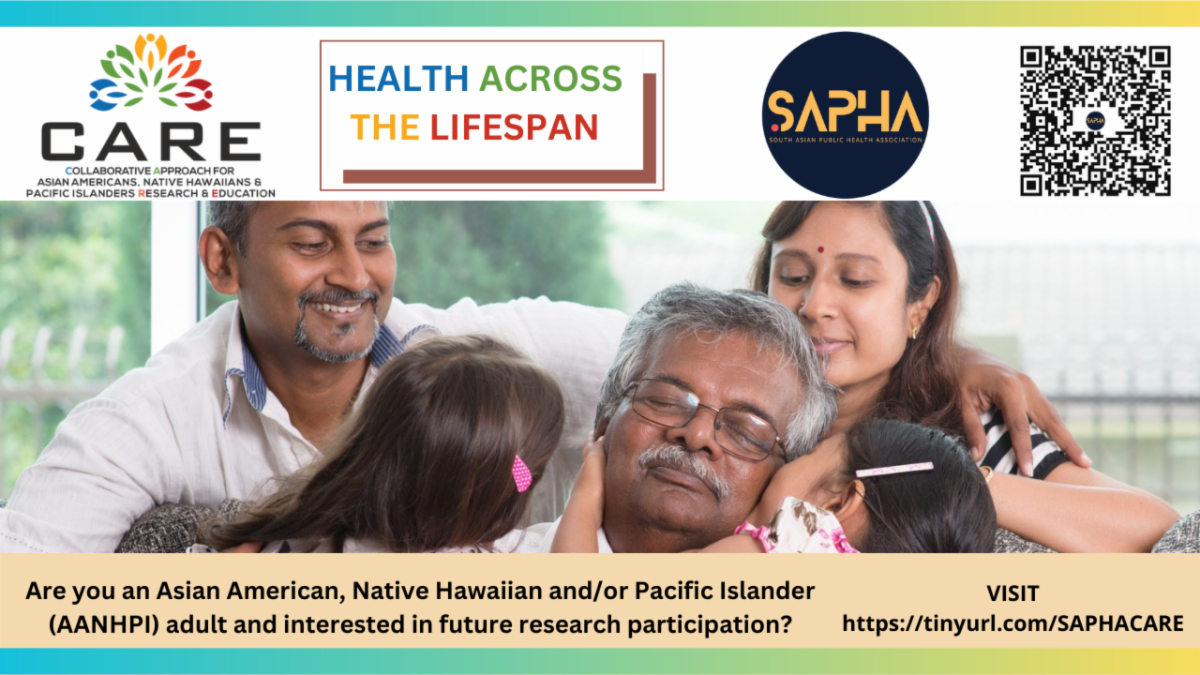
We’re excited to support the
Collaborative Approach for Asian Americans, Native Hawaiians, and Pacific Islanders Research and Education (CARE) 2.0 Study
, an NIH-funded effort to build a diverse registry of AANHPI adults interested in participating in future health research, including studies on aging, Alzheimer’s disease and related dementias, caregiving, and other important health topics across the lifespan.
If you self-identify as Asian, Asian American, Native Hawaiian and/or Pacific Islander, are 18+, live in the U.S. or U.S. Associated Pacific Islands, and can read or speak one of several languages (including English, Mandarin, Hindi, Tagalog, and more), you’re eligible to join!
Participation is voluntary, and all information collected is de-identified to
protect your privacy.
By signing up for the CARE registry, you may be contacted about research opportunities that could help improve health outcomes in our communities. Your participation can help ensure that AANHPI voices are represented in science.
✅
Sign Up for the Care 2.0 Study Here
|
|
|
By the Numbers: AANHPIs and Health
|
|
|
In a recent community poll,
41% of AAPI adults
cited health care as the important problem facing them
and their family
. With Congress preparing for a pivotal vote on health insurance subsidies, it’s critical for us to translate data and insights into action.
AAPI Data
is
excited to share their newest
By the Numbers
guide, a deep dive into AAPI health that features:
-
Key data on insurance coverage, disability, mental health and more
-
Timely public opinion insights on AAPI priorities around health
-
Essential policy background on hot button issues
-
Explore the data driving one of the most urgent issues for AAPI communities today.
“Our recent AAPI Policy Priorities Survey demonstrated that healthcare is one of the most important issues facing AAPIs and their families,” said
Gregg Orton, National Director of the National Council of Asian Pacific Americans
. “Given recent Congressional actions around health coverage, it’s vital that we are tuned in. This guide will be an important resource as our coalition continues to rally around the issues that matter most to AAPIs and advocate for affordable healthcare for all.
✅
Read AAPI Data's By the Numbers Guide Here
|
|
|
ASPIRE Asian American Cohort Study
|
|
|
The
ASPIRE Asian American Cohort Study
, a
first-of-its-kind national research effort
is focused on understanding the causes of cancer in Asian American communities.
ASPIRE aims to build a diverse cohort representing Asian Americans from across the United States, the first study of its scale and scope, to help uncover what drives cancer risk and guide better prevention efforts for future generations.
Participants can contribute by completing surveys over time, with the option to provide saliva samples, and all activities can be done from home. This study helps fill critical gaps in research and ensures that Asian American voices and health experiences are represented.
✅
Click here to get involved
|
|
🧠
Americans Feeling More Holiday Stress
This Year
🧠
|
|
A recent
American Psychiatric Association (APA)
Healthy Minds Poll finds that 41% of U.S. adults expect more stress around the holidays this year compared with last year — a significant jump from 28% in 2024 and 29% in 2023. Younger adults (18–34) are especially likely to feel this increase in stress.
While many people still look forward to holiday traditions like seeing family and friends, enjoying good food, and giving gifts, concerns about finances, grief and loss, family dynamics, and loneliness are top stressors for the season.
Broader worries about the economy, health care, political tensions, and social issues also contribute to anxiety during this time of year.
Despite these pressures, a growing share of people report that the holidays have a
positive impact
on their mental health.
✅
Read APA's full report on Stress in America here
|
|
|
New Study on Iron-Rich foods in South Asia
|
|
|
A recent study,
“Consumption of iron-rich foods and its associated factors among South Asian children aged 6–23 months,”
published in
Springer Nature Scientific Reports,
highlights important gaps in early childhood nutrition across the region. Researchers found that many young children are not consuming enough iron-rich foods, a concern given iron’s essential role in healthy growth, brain development, and preventing anemia.
Using multilevel analysis across several South Asian countries, the study identified key factors linked to higher iron intake including maternal education, household wealth, access to health services, and community-level nutrition awareness.
The findings underscore the need for continued investment in family nutrition education, affordable nutrient-dense foods, and programs that support caregivers during the critical first two years of life
✅
Read the full study here
|
|
|
Know someone who might enjoy these newsletters?
Ask them to sign up for our
email list here
.
|
|
|
Follow us on social media for tips, resources,
and community health updates
|
|
|
|
|