SAPHA - South Asian Public Health Association - logo

Newsletter - February 2026

February 2026 Newsletter: South Asian Health Advocacy Efforts


VOLUME 6 | ISSUE 2

As we welcome February and observe Heart Month, we are reminded of the urgent need to advance cardiovascular health within our community. South Asians face a disproportionately higher risk of heart disease, with studies showing that nearly 50% of heart attacks occur before the age of 50. On average, South Asians develop coronary artery disease up to a decade earlier than the general population. These sobering statistics underscore the importance of targeted education, dedicated research, and culturally relevant resources to address and reduce this growing health disparity.

Over the past few years, we have deepened our commitment to advancing South Asian heart health. We strengthened our collaboration with OurHealth, expanded academic partnerships to support national studies focused on South Asian cardiovascular risk, and continued to grow our Cardiovascular and Diabetes Toolkit to better equip individuals, clinicians, and public health professionals with culturally relevant resources.

Through our South Asian Research Hub and our spotlight on South Asian public health professionals, we are also amplifying the science and the stories driving innovation and shaping the future of heart health. Together, we can build a stronger foundation for prevention, early detection, and equity in cardiovascular care. 

Welcome to our New Board Members

We are thrilled to welcome our newest Board members: Mira Agneshwar, Aisha Bhimla, and Syeda Hasan. We’re excited to learn from their experiences, grow alongside their leadership, and work together to strengthen and serve the SAPHA community. 

More information about our Board of Directors can be found here

The Heart Risks That Medicine Kept Missing

New research from University of California, San Francisco is reshaping what we thought we knew about heart health in South Asian communities. A groundbreaking study reveals that traditional measures like BMI may miss dangerous “hidden” fat and overlook risk in patients who appear healthy by standard tests. In this feature for UCSF Magazine, Rachel Tompa explores how these findings are challenging long-held assumptions and transforming the way doctors screen for heart disease. Read the article here. 

Funding Early-Stage Research and Training in Women's Health

The Foundation for Women's Wellness supports innovative early-stage research and professional development to improve women’s health. Research Awards fund short-term studies at U.S. medical institutions focused on major women’s health concerns, including cardiovascular disease, female cancers, hormone-related health, and diseases disproportionately affecting women. Fellowship Awards support emerging physicians and scientists pursuing advanced training in women’s health disciplines. Learn more at The Foundation for Women’s Wellness

Organization Spotlight: South Asian Heart Center

Founded in 2006 by El Camino Health, the South Asian Heart Center (SAHC) was established to combat the high incidence of heart disease impacting the urban South Asian population. SAHC addresses heart disease using a culturally appropriate lifestyle approach, through community awareness, education, screening, coaching, and research. 

SAHC has received local, state and national recognition particularly for two programs AIM to PreventTM and STOP-DTM focusing on both heart disease and diabetes prevention and management. Accomplishments include reaching over 125,000 community members, increased screening, coaching and education (26%), building a referring network of over 500 physicians, and positive participants outcomes in weight loss (63%), lowered blood sugar (25%), and event-free survival (98%). 


You can follow the South Asian Heart Center by checking them out on X (formerly Twitter) , Instagram , YouTube , LinkedIn , and Facebook

Opportunity for Former and Current New York & New Jersey Service Providers to Inform Needs of South Asian Women Facing Domestic Violence

Afiya Imam, a member of SAPHA’s Research Committee, is conducting her honors thesis on how domestic violence (DV) service providers construct and address the needs of South Asian survivors. The purpose of the research is to center South Asian focused organizations that address the unique challenges South Asian women face in navigating DV. 

Through in-person interviews, Afiya is looking to learn from former and current service providers from organizations in the NY/NJ area about the work they do with DV survivors. Appropriate ethical and confidential measures will be maintained for the interview process, abiding by IRB approved protocols.


If interested in being part of these interviews, please contact Afiya directly via email (ahi2009@nyu.edu). 

Research Requests and Study Highlights

Are you recruiting participants for a study or interested in having your recent publication featured in our newsletter? We’d love to help amplify your work.

To be considered, please email saphaboard@gmail.com with the following:

  • Study recruitment: Submit flyers in .png format
  • Publications: Include a link to the full publication


We look forward to supporting and sharing your research with our community.

Share the Love by Supporting SAPHA's Mission

As we move through February, a month centered on care and connection, we’re inspired to continue building on the incredible momentum from our recent Conference and Gala and to deepen SAPHA’s impact in the year ahead.

Your generosity fuels the work that matters. With your support, we’re able to expand vital initiatives like the National South Asian Health Database, our year-round webinar series, practical toolkits and resources for public health professionals, and meaningful networking and mentorship opportunities for students and emerging leaders.

A gift this February is more than a donation—it’s an investment in community-centered programs, shared learning, and lasting connections. Together, we can continue advancing health equity and strengthening the South Asian public health community throughout 2026 and beyond.


Thank you for being part of our community.

Donate to expand South Asian public health today

Know someone who might enjoy these newsletters?

Ask them to sign up for our email list here.

X Share This Email
LinkedIn Share This Email

Follow us on social media for tips, resources,

and community health updates

Facebook  Instagram  LinkedIn  Web  X  YouTube

January 2026 Newsletter: Happy New Year from SAPHA!


VOLUME 6 | ISSUE 1

A Letter from SAPHA's President

Dear Colleagues,

I hope this message finds you well as we welcome a new year and renew our shared commitment to advancing the health and wellbeing of South Asian communities across the United States. As I enter my fifth year serving as President of SAPHA, I remain deeply humbled by the trust you place in this organization and inspired by all we have built together. 2025 marked one of the most transformational periods in SAPHA’s 26-year history, as highlighted by our inaugural national conference and gala, reflecting the depth, growth, and collective leadership of our community.

Last year, SAPHA achieved significant milestones that include:

Advancing Research and Knowledge: SAPHA deepened its role as a national resource for South Asian health scholarship by launching the South Asian Research Hub, a first-of-its-kind platform functioning as a “South Asian PubMed” where researchers, practitioners, and community members can easily explore the full landscape of studies and data on South Asian health. We also expanded our commitment to data visibility through the launch of our Disaggregating Diversity initiative, which compiles and links all publicly available datasets that provide South Asian–specific health outcomes data, making it easier for advocates, researchers, and policymakers to access meaningful, community-relevant information.

Developing High-Impact Educational and Research Resources: SAPHA continued producing tools that bridge research, advocacy, and community education. This included new toolkits on caste and discrimination, climate and environmental health, and combating mental health misinformation. We also released our Misinformation and South Asian Health Landscape Report, a research product that examines how misinformation spreads within South Asian American communities across topics such as vaccines, chronic disease, mental health, and reproductive health. Through case studies, cultural analysis, and policy recommendations, the report highlights the real-world consequences of misinformation and offers strategies for culturally grounded intervention. In addition, SAPHA expanded its vaccine education efforts by creating two new resources: the Vaccine Myth-Buster One-Pager for communities and the Vaccine Hesitancy in South Asian Communities Provider Resource Guide.

Engaging Events and Community Education: Throughout 2025, SAPHA continued to bring together experts, advocates, and community members through high-impact events. We hosted a webinar on cancer prevention, a health equity workshop on economic justice, and a workshop on addressing vaccine hesitancy. SAPHA also supported the data collection efforts of the Collaborative Approach for Asian Americans, Native Hawaiians, and Pacific Islanders Research and Education (CARE) 2.0 study. In alignment with this partnership, we conducted recruitment and outreach events to strengthen study representation and community engagement. If you’re a researcher interested in adding SAPHA as a community partner on research studies for community outreach, reach out to us

Our Inaugural SAPHA Gala and National Conference: One of the most significant milestones in SAPHA’s history took place in 2025, when we convened our first-ever national conference and gala. This landmark gathering brought together researchers, policymakers, clinicians, advocates, and community partners for a powerful two days of learning, collaboration, and celebration. The fireside chat with Asma Khalid and Congresswoman Pramila Jayapal served as a powerful centerpiece for the gala, elevating national dialogue on South Asian health equity and reinforcing the importance of collective action in this moment. We were especially grateful to the many past SAPHA board members who joined us in person, supported planning efforts, contributed as speakers, and continued to champion SAPHA’s mission through their time, expertise, and financial generosity. Their presence underscored the continuity of SAPHA’s legacy and the collective strength of our national network.

Strengthening National Presence and Coalition-Building: SAPHA continued to expand its presence on the national stage through active participation in key convenings and partnerships. We contributed to national discussions at Roundglass India Center’s South Asian Health Research and Rights webinar and at the APAICS 2025 Health Summit, where SAPHA helped shape conversations on disaggregating data for AANHPI health equity. In parallel, SAPHA strengthened its collaborative advocacy work by joining the South Asian Coalition, expanding opportunities to coordinate efforts across organizations serving South Asian communities. Throughout the year, we also released timely statements on current events and continued building relationships with partners across sectors.


These accomplishments reflect the dedication, creativity, and passion of our board members, network, committee members, interns, and supporters. Your collaboration continues to be the driving force behind SAPHA’s impact.

As we enter 2026, we do so during a time of continued challenges for the public health field, including sustained funding cuts, shifting federal directives, rapidly evolving vaccine and health guidelines, and a fast-moving policy environment that affects the daily realities of the communities we serve. Many South Asian Americans are navigating heightened uncertainty, ongoing policy changes, and increased fear due to evolving immigration enforcement actions. These conditions underscore the urgent need for culturally grounded, trusted public health infrastructure. Even in this unpredictable environment, SAPHA remains committed to being a steady and reliable voice by offering evidence-based resources, community-informed guidance, and responsive advocacy. Together, we will navigate 2026 with resilience, collaboration, and a shared commitment to health equity.

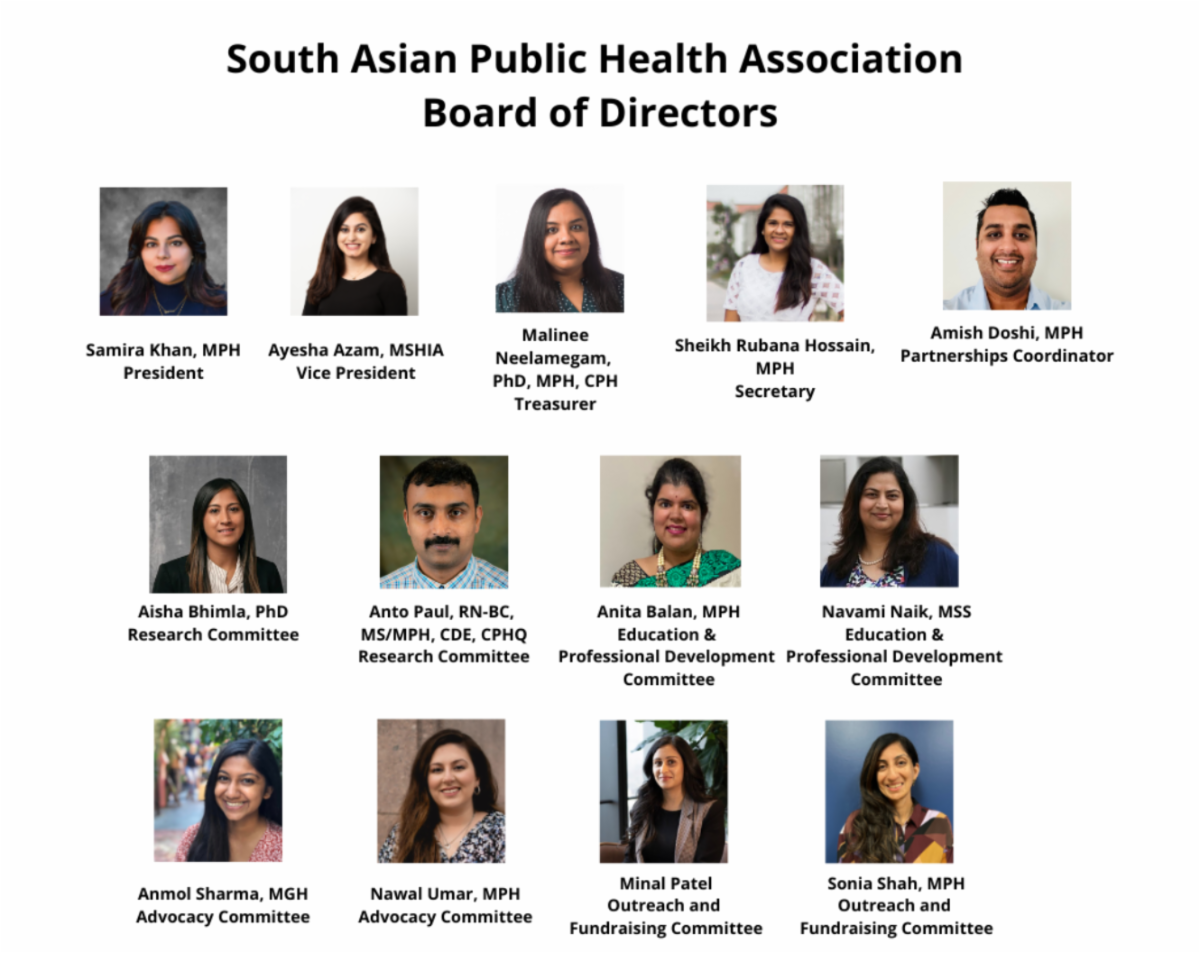
As we look ahead, our work will continue to be shaped by the strength, dedication, and leadership of the people who make SAPHA what it is. Our progress is only possible because of the individuals who devote their time, expertise, and heart to this organization. I want to express my deepest gratitude to our outgoing board members for their tremendous contributions to SAPHA: Pavithra Suresh, Anita Makkenchery, and Mushira Khan,. To our continuing board members, Ayesha Azam, Malinee Neelamegam, Rubana Hossain, Amish Doshi, Anto Paul, Navami Naik, Anita Balan, Nawal Umar, Anmol Sharma, Sonia Shah, and Minal Patel, and to those returning to leadership, including Aisha Bhimla, PhD, who rejoins the board as Co-Chair of the Research Committee: welcome and thank you for your continued dedication to SAPHA’s mission. I am excited to work alongside all of you to build on our accomplishments.

I encourage each of you to share your ideas on how SAPHA can continue to grow and better serve our community. For any inquiries or suggestions, please reach out to us at admin@sapha.org.

With gratitude,

Samira Khan, MPH

President, South Asian Public Health Association

Introducing our Board Members

More information about our Board of Directors can be found here.

Addressing an Overlooked Population: The Role of Discrimination and Violence in Depression Among South Asian Female College Students

A new study published in the Journal of Public Health International  from George Washington University School of Public Health examines how discrimination and gender-based violence affect the mental health of South Asian women attending college in the United States. 

Study participants included 673 South Asian female college students in the U.S. found that discrimination and violence are major contributors to depression in this population. More than half reported experiencing discrimination on campus, two-thirds reported violence during college, and one in four met the criteria for depression.

 Day-to-day discrimination and experiences of violence were both strong predictors of depressive symptoms, even after accounting for demographic factors. Bisexual and questioning students faced especially high risk. The findings highlight discrimination and violence as critical social determinants of mental health and point to the urgent need for culturally responsive counseling services, intersectional campus policies, and evidence-based interventions to support South Asian women in higher education.

Read the full study here

For South Asians and Medical Providers Across Dallas-Ft. Worth Metroplex and Texas - Opportunity to Inform Type II Diabetes Program Development

As part of SAPHA’s continued support (in partnership with the University of North Texas Health Science Center) for the NIH’s Community Engagement Alliance (CEAL) grant, we are sharing an opportunity for South Asians and medical providers across Texas (particularly those in the Dallas-Ft. Worth Metroplex area) to inform the development of a Community Health Ambassador program to address the high prevalence of type II diabetes in the South Asian community in the Dallas-Fort Worth Metroplex. Participation is voluntary and a $10 Amazon gift card will be provided to each respondent. Your responses will help create a program that is culturally relevant, respectful, and responsive to the unique needs, experiences, and traditions of South Asian individuals and families. Eligibility information and links to each of the surveys (patient and provider are below):

Patient survey eligibility is based on the following factors:

  • Must be at least 18 years old
  • Must be of South Asian descent (Indian, Pakistani, Bangladeshi, Sri Lankan, Nepali, Bhutanese, or Maldivian)
  • Does not need to have type II diabetes or have a family history of it, but should feel that they are at risk for developing diabetes in the future

Patient survey: https://unthsc.qualtrics.com/jfe/form/SV_6L8bXEGjrYbvtQ2 

Provider survey eligibility is based on the following factors:

  • Must be at least 18 years old
  • Must currently practice medicine and work with South Asian patients
  • Must care for patients who have type II diabetes or are at risk for diabetes

Provider survey: https://unthsc.qualtrics.com/jfe/form/SV_eJM7jqVfr2IRZiu 

Upon completion of the survey, please write in either Amish Doshi or SAPHA as the name of referral.

Research Requests and Study Highlights

Are you recruiting participants for a study or interested in having your recent publication featured in our newsletter? We’d love to help amplify your work.

To be considered, please email saphaboard@gmail.com with the following:

  • Study recruitment: Submit flyers in .png format
  • Publications: Include a link to the full publication


We look forward to supporting and sharing your research with our community.

Start the New Year by Supporting SAPHA's Mission

As we look ahead to a new year, we’re excited to build on the momentum from our recent Conference and Gala and continue growing SAPHA’s impact.

Your support makes it possible for us to expand essential programs, including the National South Asian Health Database, our year-round webinar series, toolkits and resources for public health professionals, and networking and mentorship opportunities for students and emerging leaders.

A gift at the start of the year helps set the foundation for more community-centered programs, learning opportunities, and connections in the months ahead. Together, we can continue advancing health equity and strengthening the South Asian public health community in 2026 and beyond.

Thank you for being part of this work.


Donate to expand South Asian public health today

Know someone who might enjoy these newsletters?

Ask them to sign up for our email list here.

X Share This Email
LinkedIn Share This Email

Follow us on social media for tips, resources,

and community health updates

Facebook  Instagram  LinkedIn  Web  X  YouTube

South Asian Public Health Association Spotlight Series


SEASON 1 | EPISODE 11

South Asian Public Health Association Spotlight Series

SAPHA continues its journey into the world of podcasts with our latest installment! Introducing the eighth episode of the South Asian Public Health Association Spotlight Series, where we dive deep into the extraordinary careers and journeys of public health pioneers, with a special focus on the South Asian community.

In commemoration of the 25th anniversary of the South Asian Public Health Association, each episode promises enlightening discussions, motivational narratives, and an intimate exploration of the impactful contributions made by former SAPHA board members, shaping the landscape of public health.

We present our eleventh episode of the series featuring Isha Weerasinghe, MSc

Our eleventh episode features Isha Weerasinghe. Isha is the Associate Director for Mental Health and Well-Being at the Center for Law and Social Policy, focusing on youth, young adults, and mothers. She previously served as Director of Policy and Advocacy at the Association for Asian Pacific Community Health Organizations , where she worked on improving access to culturally and linguistically appropriate care for Asian Americans, Native Hawaiians, and Pacific Islanders (AA&NHPIs). She also served on the Board of Directors for SAPHA on the membership committee and executive committee during 2015- 2017. 

Listen to us on Youtube!

Listen to us on Spotify!

Learn more about Isha below:

Isha Weerasinghe is the Center for Law and Social Policy’s associate director of mental health and well-being. She works on reframing and making improvements to the mental health system, focusing on communities of color and other communities on the margins. Ms. Weerasinghe previously was the director of policy and advocacy at the Association for Asian Pacific Community Health Organizations (AAPCHO), where she advocated for better access to linguistically concordant and culturally responsive care for Asian Americans, Native Hawaiians, and Pacific Islanders (AA&NHPIs). She also led/participated in city and national coalition building and provided policy guidance on the local and national-levels, for AA&NHPI-serving community health centers and organizations, in health access and equity. Ms. Weerasinghe conducted community based participatory research, as well as local and state policy advocacy at New York University’s Center for the Study of Asian American Health (CSAAH), working within New York City and New York state. She started her federal policy career to improve the lives of people living with hepatitis B. Isha has a B.A. in biology from Bryn Mawr College, and a M.Sc. in health policy and demography from the London School of Economics and Political Science. She is the board Vice Chair of Fihankra Akoma Ntoaso (FAN DC) and is the board Chair of 9to5: National Association of Working Women.

Listen to us on Youtube!

Listen to us on Spotify!

Subscribe to SAPHA’s Spotlight Series to hear more captivating discussions with trailblazers in public health.

YouTube

Spotify

Thanks for your interest in SAPHA!

We are continually striving to enhance the health and well-being of our diverse South Asian communities. Through advocacy, education, and meaningful community partnerships, we are dedicated to making a positive impact. Learn more about our mission or contribute to our cause by visiting sapha.org!

If you enjoyed this podcast and want to support our efforts in creating engaging content, please consider making a donation.

DONATE

Subscribe to SAPHA’s Spotlight Series to hear more captivating discussions with trailblazers in public health.


Follow us on Youtube and Spotify to be the first to access our podcasts!

Know someone who might enjoy these emails?

Ask them to sign up for our email list here.

Facebook  X  Linkedin  Instagram  YouTube

South Asian Public Health Association Spotlight Series


SEASON 1 | EPISODE 10

South Asian Public Health Association Spotlight Series

SAPHA continues its journey into the world of podcasts with our latest installment! Introducing the tenth episode of the South Asian Public Health Association Spotlight Series, where we dive deep into the extraordinary careers and journeys of public health pioneers, with a special focus on the South Asian community.

In commemoration of the 25th anniversary of the South Asian Public Health Association, each episode promises enlightening discussions, motivational narratives, and an intimate exploration of the impactful contributions made by former and current SAPHA board members, shaping the landscape of public health.

We present our newest episode of the series featuring Shilpa Patel, PhD, MPH

Listen to us on Youtube!

Listen to us on Spotify!

Our tenth episode features Dr. Shilpa Patel. Dr. Patel was the Co-Chair/Co-President of SAPHA from 2004-2006 and also an author of one of the chapters of SAPHA’s monumental Brown Paper. She brings over 24 years of public health experience. Throughout her career, she has designed and implemented epidemiological and behavioral studies both domestically and globally, with a strong focus on HIV prevention, and the intersectionality of HIV and violence. Dr. Patel’s previous roles include Senior Scientist at the Centers for Disease Control and Prevention (CDC) in the Global Health Center; and the National Center for HIV, Viral Hepatitis, STD, and Tuberculosis Prevention. Specifically, through the PEPFAR program, she served as a country advisor for the implementation of the DREAMS (Determined, Resilient, Empowered, AIDS-free, Mentored and Safe) Initiative, which aims at decreasing rates of HIV among adolescent girls and young women in countries with the highest burden. She also served as the Co-Chair of the Mental Health and Substance Use Workgroup in the Division of HIV at the CDC. In addition, Dr. Patel teaches and mentors students as an Adjunct Professor at the Emory University, Rollins School of Public Health in Atlanta, Georgia. Dr. Patel has also presented at numerous scientific conferences and has co-authored several publications in peer-reviewed journals. 

Listen to us on Youtube!

Listen to us on Spotify!

12/3 Giving Tuesday

As we approach Giving Tuesday, we reflect on the positive impact we've made and the important work still to come. At SAPHA, we are committed to enhancing the health and well-being of South Asian communities through advocacy, education, and meaningful partnerships. With your support, we can continue making a real difference.

This Giving Tuesday, we invite you to join us in this mission.

Your generous donation helps us create and share valuable content, including this podcast, which highlights issues that matter most to South Asians.

Together, we can bring you even more insightful episodes, expand our reach, and create lasting change.

Visit sapha.org to learn more about our mission and donate below.

Thank you for being a vital part of the SAPHA community!

DONATE

Subscribe to SAPHA’s Spotlight Series to hear more captivating discussions with trailblazers in public health.


Follow us on Youtube and Spotify to be the first to access our podcasts!

Know someone who might enjoy these emails?

Ask them to sign up for our email list here.

Facebook  X  Linkedin  Instagram  YouTube

South Asian Public Health Association Spotlight Series

SEASON 1 | EPISODE 9

South Asian Public Health Association Spotlight Series

SAPHA continues its journey into the world of podcasts with our latest installment! Introducing the ninth episode of the South Asian Public Health Association Spotlight Series, where we dive deep into the extraordinary careers and journeys of public health pioneers, with a special focus on the South Asian community.

In commemoration of the 25th anniversary of the South Asian Public Health Association, each episode promises enlightening discussions, motivational narratives, and an intimate exploration of the impactful contributions made by former and current SAPHA board members, shaping the landscape of public health.

We present our ninth episode of the series featuring Samira Khan, MPH

Our ninth episode features Samira Khan, MPH, the current President of SAPHA. Samira has been with SAPHA since 2018 and has been serving as the President since 2022. She is also the Assistant Director of Research and Clinical Initiatives in the Division of Pulmonary, Critical Care and Sleep Medicine at the Icahn School of Medicine, where she collaborates with divisional leadership to spearhead the development of a Respiratory Service Line and create comprehensive dashboards to track performance, quality metrics, and health outcomes in both inpatient and outpatient care. Tune in to hear Samira’s journey in public health, the challenges faced by South Asian communities in health, and her insights into SAPHA’s impact over the past 25 years and its plans for the future.

Listen to us on Youtube!

Listen to us on Spotify!

Learn more about Samira Khan below:

Samira Khan, MPH has been with SAPHA for 7 years, starting on the fundraising committee in 2018, advancing to Secretary in 2021, and becoming President in 2022. Alongside the board, she has led SAPHA’s efforts in advocacy, research, health education, and partnerships to address critical health issues in South Asian communities. Under her leadership, SAPHA recently secured $20,000 from NCAPA to address health misinformation and advance racial equity, and received subawards for two NIH grants. SAPHA has also gained national recognition, receiving invitations to the White House and participating in roundtables with the Secretary of Health and other key figures. Samira’s participation in programs like the Climate Health Organizing Fellowship and the Institute for Healthcare Improvement’s Pursuing Equity Learning Network has strengthened her advocacy for health equity.

Samira received a Bachelor of Science in Psychology at the CUNY City College of New York, where she completed an honors thesis on the cognitive, affective, and social correlates of avolition in individuals with schizophrenia and pursued a global health study abroad at the Comprehensive Rural Health Project (CRPH) in Jamkhed, India. During her time at CRPH she studied international health policy and community based primary healthcare models. She later earned a Master’s in Public Health from Hofstra University, where her research focused on provider communication and health behaviors in Muslim populations.

In her current role as Assistant Director of Research and Clinical Initiatives at Mount Sinai, Samira collaborates with divisional leadership to develop and implement strategic initiatives to improve inpatient and outpatient quality of care, optimize performance, and enhance patient outcomes. She oversees the development of comprehensive dashboards to track key indicators and works closely with pulmonary disease management leads to ensure data-driven decision-making. Additionally, Samira is also the Research Manager for Dr. Neomi Shah’s lab, where the team investigates the link between obstructive sleep apnea and cardiovascular disease using advanced techniques in epidemiology, cardiovascular imaging, proteomics, and machine learning. In this capacity, she manages clinical research operations, grant applications, project development, and ensures regulatory compliance across multiple studies.

With nearly a decade of experience, Samira combines her expertise in clinical research, strategic planning, and health equity to drive impactful change in healthcare, focusing on improving access and outcomes for marginalized communities.

Listen to us on Youtube!

Listen to us on Spotify!

Subscribe to SAPHA’s Spotlight Series to hear more captivating discussions with trailblazers in public health.

YouTube

Spotify

Thanks for your interest in SAPHA!

We are continually striving to enhance the health and well-being of our diverse South Asian communities. Through advocacy, education, and meaningful community partnerships, we are dedicated to making a positive impact. Learn more about our mission or contribute to our cause by visiting sapha.org!

If you enjoyed this podcast and want to support our efforts in creating engaging content, please consider making a donation.

DONATE

Subscribe to SAPHA’s Spotlight Series to hear more captivating discussions with trailblazers in public health.


Follow us on Youtube and Spotify to be the first to access our podcasts!

Know someone who might enjoy these emails?

Ask them to sign up for our email list here.

Facebook  X  Linkedin  Instagram  YouTube

cross linkedin facebook pinterest youtube rss twitter instagram facebook-blank rss-blank linkedin-blank pinterest youtube twitter instagram