|
A Letter from SAPHA's President
Dear Colleagues,
I hope this message finds you well as we welcome a new year and renew our shared commitment to advancing the health and wellbeing of South Asian communities across the United States. As I enter my fifth year serving as President of SAPHA, I remain deeply humbled by the trust you place in this organization and inspired by all we have built together. 2025 marked one of the most transformational periods in SAPHA’s 26-year history, as highlighted by our inaugural national conference and gala, reflecting the depth, growth, and collective leadership of our community.
Last year, SAPHA achieved significant milestones that include:
Advancing Research and Knowledge: SAPHA deepened its role as a national resource for South Asian health scholarship by launching the South Asian Research Hub, a first-of-its-kind platform functioning as a “South Asian PubMed” where researchers, practitioners, and community members can easily explore the full landscape of studies and data on South Asian health. We also expanded our commitment to data visibility through the launch of our Disaggregating Diversity initiative, which compiles and links all publicly available datasets that provide South Asian–specific health outcomes data, making it easier for advocates, researchers, and policymakers to access meaningful, community-relevant information.
Developing High-Impact Educational and Research Resources: SAPHA continued producing tools that bridge research, advocacy, and community education. This included new toolkits on caste and discrimination, climate and environmental health, and combating mental health misinformation. We also released our Misinformation and South Asian Health Landscape Report, a research product that examines how misinformation spreads within South Asian American communities across topics such as vaccines, chronic disease, mental health, and reproductive health. Through case studies, cultural analysis, and policy recommendations, the report highlights the real-world consequences of misinformation and offers strategies for culturally grounded intervention. In addition, SAPHA expanded its vaccine education efforts by creating two new resources: the Vaccine Myth-Buster One-Pager for communities and the Vaccine Hesitancy in South Asian Communities Provider Resource Guide.
Engaging Events and Community Education: Throughout 2025, SAPHA continued to bring together experts, advocates, and community members through high-impact events. We hosted a webinar on cancer prevention, a health equity workshop on economic justice, and a workshop on addressing vaccine hesitancy. SAPHA also supported the data collection efforts of the Collaborative Approach for Asian Americans, Native Hawaiians, and Pacific Islanders Research and Education (CARE) 2.0 study. In alignment with this partnership, we conducted recruitment and outreach events to strengthen study representation and community engagement. If you’re a researcher interested in adding SAPHA as a community partner on research studies for community outreach, reach out to us!
Our Inaugural SAPHA Gala and National Conference: One of the most significant milestones in SAPHA’s history took place in 2025, when we convened our first-ever national conference and gala. This landmark gathering brought together researchers, policymakers, clinicians, advocates, and community partners for a powerful two days of learning, collaboration, and celebration. The fireside chat with Asma Khalid and Congresswoman Pramila Jayapal served as a powerful centerpiece for the gala, elevating national dialogue on South Asian health equity and reinforcing the importance of collective action in this moment. We were especially grateful to the many past SAPHA board members who joined us in person, supported planning efforts, contributed as speakers, and continued to champion SAPHA’s mission through their time, expertise, and financial generosity. Their presence underscored the continuity of SAPHA’s legacy and the collective strength of our national network.
Strengthening National Presence and Coalition-Building: SAPHA continued to expand its presence on the national stage through active participation in key convenings and partnerships. We contributed to national discussions at Roundglass India Center’s South Asian Health Research and Rights webinar and at the APAICS 2025 Health Summit, where SAPHA helped shape conversations on disaggregating data for AANHPI health equity. In parallel, SAPHA strengthened its collaborative advocacy work by joining the South Asian Coalition, expanding opportunities to coordinate efforts across organizations serving South Asian communities. Throughout the year, we also released timely statements on current events and continued building relationships with partners across sectors.
These accomplishments reflect the dedication, creativity, and passion of our board members, network, committee members, interns, and supporters. Your collaboration continues to be the driving force behind SAPHA’s impact.
As we enter 2026, we do so during a time of continued challenges for the public health field, including sustained funding cuts, shifting federal directives, rapidly evolving vaccine and health guidelines, and a fast-moving policy environment that affects the daily realities of the communities we serve. Many South Asian Americans are navigating heightened uncertainty, ongoing policy changes, and increased fear due to evolving immigration enforcement actions. These conditions underscore the urgent need for culturally grounded, trusted public health infrastructure. Even in this unpredictable environment, SAPHA remains committed to being a steady and reliable voice by offering evidence-based resources, community-informed guidance, and responsive advocacy. Together, we will navigate 2026 with resilience, collaboration, and a shared commitment to health equity.
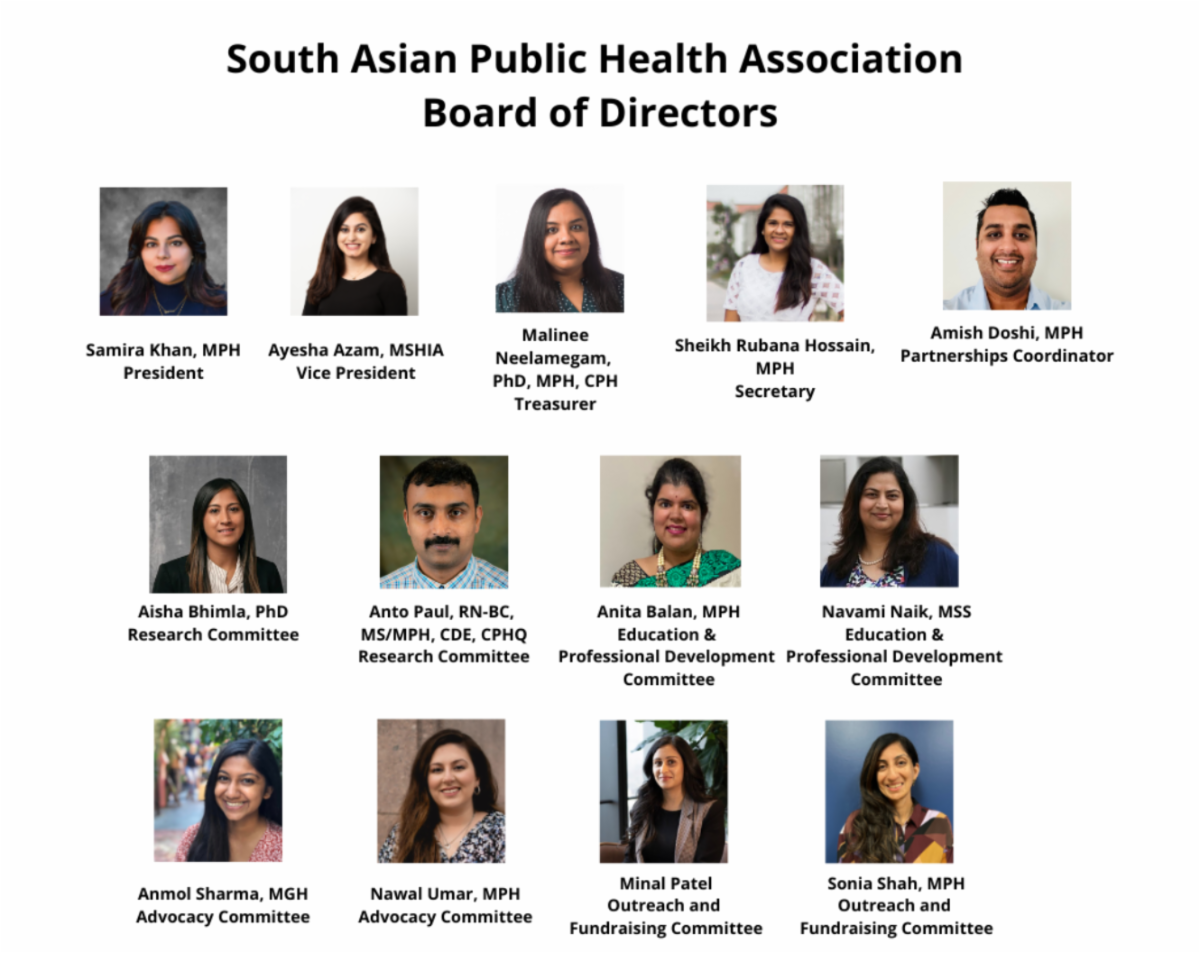
As we look ahead, our work will continue to be shaped by the strength, dedication, and leadership of the people who make SAPHA what it is. Our progress is only possible because of the individuals who devote their time, expertise, and heart to this organization. I want to express my deepest gratitude to our outgoing board members for their tremendous contributions to SAPHA: Pavithra Suresh, Anita Makkenchery, and Mushira Khan,. To our continuing board members, Ayesha Azam, Malinee Neelamegam, Rubana Hossain, Amish Doshi, Anto Paul, Navami Naik, Anita Balan, Nawal Umar, Anmol Sharma, Sonia Shah, and Minal Patel, and to those returning to leadership, including Aisha Bhimla, PhD, who rejoins the board as Co-Chair of the Research Committee: welcome and thank you for your continued dedication to SAPHA’s mission. I am excited to work alongside all of you to build on our accomplishments.
I encourage each of you to share your ideas on how SAPHA can continue to grow and better serve our community. For any inquiries or suggestions, please reach out to us at admin@sapha.org.
With gratitude,
Samira Khan, MPH
President, South Asian Public Health Association
|