|
September is Suicide Prevention Month, a time to raise awareness, reduce stigma, and encourage more open conversations about mental health and suicide prevention. The National Alliance on Mental Illness 2026 theme, “Start a Conversation. Be the Difference.” reminds us that meaningful change can begin with a simple conversation: checking in, listening without judgment, and making sure people know they are not alone.
These conversations are important within South Asian communities, where cultural stigma and other barriers can make it difficult to openly discuss mental health or seek support. At SAPHA, we believe public health has an important role to play in creating spaces for these conversations and connecting our communities with culturally relevant information and resources.
This month, we’re revisiting SAPHA’s 2024 “Shattering Stigma” panel on suicide awareness in the South Asian community, re-sharing mental health facts and data, and highlighting mental health resources for South Asians. Together, these resources offer opportunities to learn more, recognize the importance of mental health, and better support ourselves and those around us.
We encourage you to explore and share these resources. As SAPHA looks ahead, we remain committed to advancing the health and well-being of South Asian communities through education, advocacy, community engagement, and greater awareness of the health issues affecting our communities.
|
|
|
Mental Health Awareness Video
|
|
|
This month we asked South Asian college students about the importance of mental health. By centering student voices, our campaign gathered valuable insights to inform more relevant, accessible, and supportive approaches to mental health awareness and resources for an important demographic. Hear their thoughts here.
|
|
Upcoming Events: Save the Date!
|
|
Healthy Aging Webinar Series: October 22
Healthy aging, early detection, and compassionate care shouldn't be luxury conversations—they are vital public health priorities. Yet, within South Asian communities, navigating cognitive decline and finding culturally sensitive care resources remains a significant challenge.
This Fall 2026, we are proud to launch a powerful Webinar Series dedicated to bridging these gaps, equipping caregivers, and fostering open, actionable dialogue. Our first webinar is scheduled for October 22. Stay tuned for more information to sign up.
|
|
|
Chai & Chat at APHA: November 1
If you’ll be at APHA in San Antonio this year, save the date for SAPHA’s annual Chai & Chat networking event!
Join us on Sunday, November 1 from 8:00–9:30 PM for an informal evening to catch up with colleagues, meet new people, and connect with others in the SAPHA community.
Location and agenda details coming soon.
|
|
|
Fall Advocacy Webinar: November 18
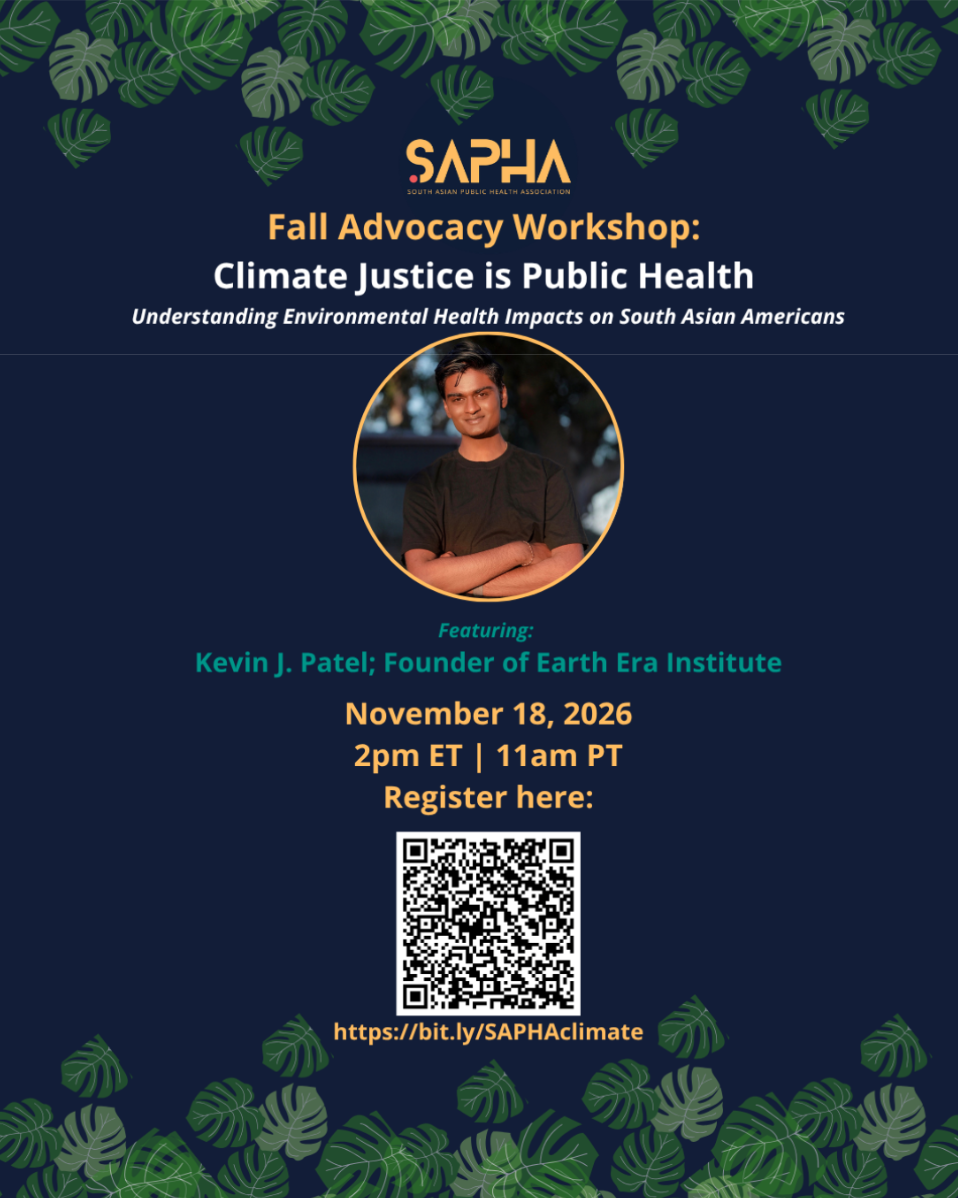
We’re excited to announce that SAPHA will be hosting an interactive advocacy workshop exploring the intersection of climate justice and public health in partnership with SAPHA’s Climate Health Taskforce, and featuring Kevin J. Patel, a climate justice advocate and Founder of Earth Era Institute and its predecessor, OneUpAction International.Participants will learn about climate advocacy, skills for intergenerational leadership on community-rooted climate solutions, and resources from SAPHA’s Climate Health Toolkit. Please register here!
|
|
SAPHA is Hiring: Paid Internships
|
|
|
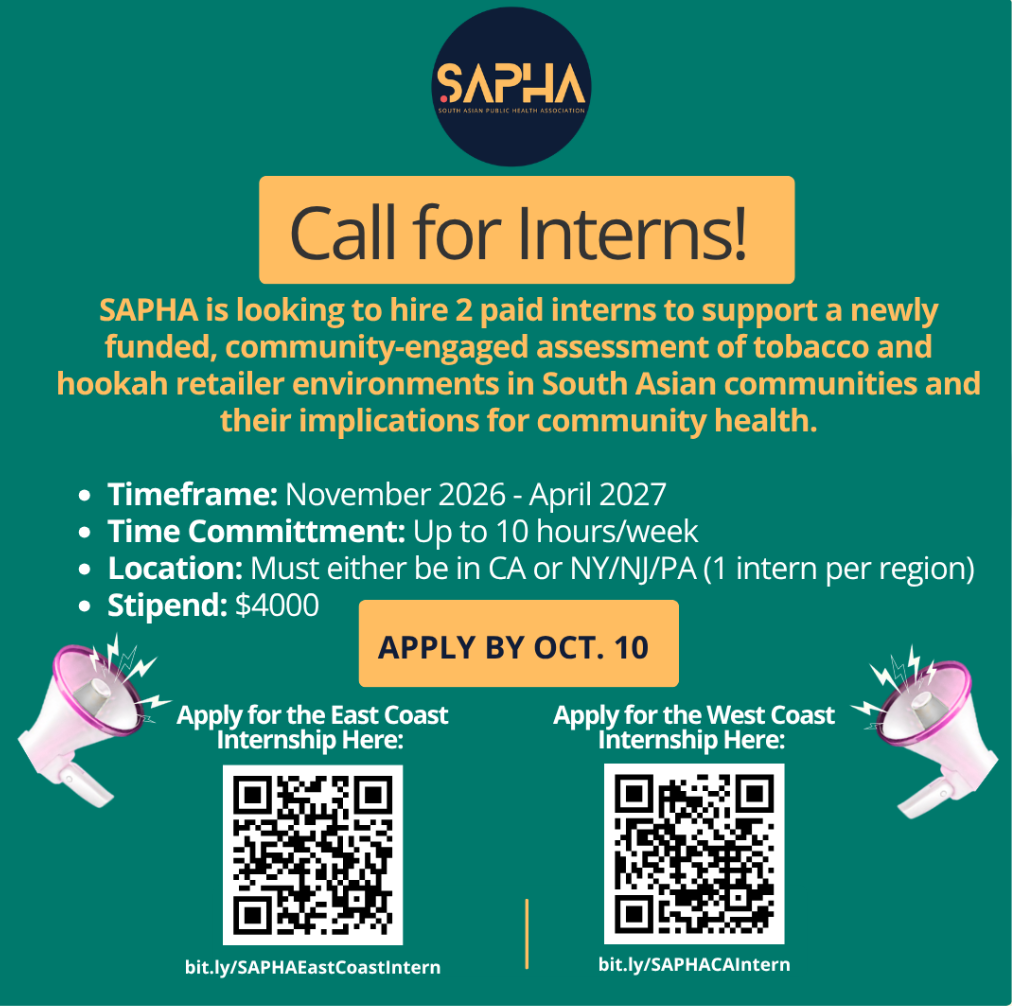
SAPHA is seeking two paid interns, one based on the East Coast and one in California, to support a newly funded project examining tobacco and hookah retailer environments in South Asian communities. The project will assess point-of-sale marketing and relevant policies while engaging South Asian communities to better understand the local tobacco retail landscape and its implications for community health.
Interns will help engage community leaders and support the formation of a community advisory board, conduct systematic observations of tobacco retail environments and interviews with tobacco shop and hookah lounge owners, and contribute to literature and policy reviews, data analysis, and project writing.
The East Coast internship will focus on Queens, Brooklyn, Long Island, Central New Jersey, and Philadelphia, while the California internship will focus on the San Francisco Bay Area, Central Valley, and Southern California. Both positions are part-time, approximately up to 10 hours per week from November 2026 through April 2027, and include a $4,000 stipend.
Applications are due October 10, 2026.
East Coast: bit.ly/SAPHAEastCoastIntern
California: bit.ly/SAPHACAIntern
For questions, contact research@sapha.org
|
|
Policy and Advocacy Spotlight
|
|
South Asian Heart Health Awareness and Research Act Reintroduced in Congress
On September 18, Reps. Pramila Jayapal (WA-07) and Joe Wilson (SC-02) and Sen. Cory Booker (D-NJ) reintroduced the bipartisan South Asian Heart Health Awareness and Research Act, legislation aimed at addressing the disproportionate burden of cardiovascular disease among South Asian Americans.
The bill would 1) provide grants to states to support awareness initiatives and educational materials; and 2) establish programs to support research regarding heart disease, type 2 diabetes and other heart-related ailments with respect to the South Asian population and other at-risk populations.
SAPHA is among the organizations endorsing the legislation, and SAPHA President Samira Khan was quoted in the reintroduction announcement, emphasizing the need for better data, culturally responsive prevention, and community-based efforts to address cardiovascular disease in South Asian communities.
Help Advance South Asian Heart Health Research
Representative Jayapal and Senator Booker are currently working on recruiting both Democratic and Republican co-sponsors for the bill. We encourage you all to reach out to your Congressional members’ offices to urge them to support the bill to help advance resources for South Asian heart health research.
To find and contact your US Senators:
-
Visit the Senate website (www.senate.gov)
- Conduct a search using the Find your Senators pull-down menu in the upper right corner (select your state and click Go)
- On the results page, click “Contact” and you will redirect to your Senator’s website, where you will contact them via their contact form (forms vary by Senator).
- Write a message asking your Senator to cosponsor the South Asian Heart Health Awareness and Research Act by contacting Senator Booker’s office and let them know your views on the legislation.
To find and contact your Representative in the House:
-
Visit the House website (https://www.house.gov)
- Enter your Zip code in the top right “Find Your Representative” box
- Click the email icon that appears below the member’s name.
- Write a message asking your Representative to cosponsor the South Asian Heart Health Awareness and Research Act by contacting Rep. Jayapal’s office.
2026 AAPI Voters Data and Narrative Toolkit
APIAVote and AAPI Data, in collaboration with NCAPA, have released the 2026 AAPI Voters Data and Narrative Toolkit ahead of the November elections. With AAPI voters among the fastest-growing voter demographics in the country, the toolkit provides evidence-based data, key facts, and tested messaging to support effective outreach and engagement.
Explore the toolkit and use these resources to strengthen AAPI voter engagement and mobilization efforts.
Census Bureau Proposing Removal of Race and Ethnicity Questions for 2030
On September 10th, the Census Bureau announced a proposed rule to remove standard race, ethnicity, and sexual orientation questions from the decennial census effective with the next national headcount in 2030. Race and ethnicity have been included on the decennial census since 1790. At a time where it is critical to push for sustained data disaggregation policies, blanket removal of these questions from the Census could cause irreparable harm to communities (including South Asians) across several areas including but not limited to civil rights protections, health research, policy development, advocacy, and anti-discrimination efforts. The National Council of Asian Pacific Americans or NCAPA (of which SAPHA is a coalition member) released a statement strongly opposing this proposal.
We encourage you to submit comments on this proposal by October 13th which the Bureau is required to review and respond to before publishing a final ruling.
25th Anniversary of 9/11
Earlier this month, SAPHA paused to remember the lives lost on September 11, 2001, and to honor the families and communities whose lives were forever changed.
For South Asian, Muslim, Sikh, Arab, and other communities, the years that followed also brought experiences of discrimination, fear, and stigma that continue to shape our communities today. As we remember, we reaffirm our commitment to compassion, belonging, and the health and well-being of all communities.
We invite you to read SAPHA’s full statement and join us in reflecting on its continued significance for our communities.
|
|
New Research: The State of Anti-South Asian Hate
|
|
|
Stop AAPI Hate recently released The State of Anti-South Asian Hate, a new research brief highlighting the experiences of South Asian communities with hate, anti-immigrant sentiment, and threats of violence.
Among the findings, 48% of South Asian adults reported experiencing a race-based hate act in 2025, while South Asians were the targets of 71% of monitored anti-Asian threats of violence between August 2024 and December 2025. The brief also documents a 109% increase in anti-South Asian slurs from 2023 to 2025.
Read the full brief to learn more about the data and the experiences shaping South Asian communities today.
|
|
|
September 21 marks World Alzheimer’s Day. South Asians remain significantly underrepresented in Alzheimer’s research, limiting our understanding of risk factors and the development of culturally-tailored approaches to prevention, diagnosis, and care. Research suggests that important dementia risk factors, including diabetes and other metabolic conditions, may affect South Asian populations differently, underscoring the need for more inclusive research.
Learn more about emerging research on Alzheimer’s and dementia in South Asian communities from Rutgers University.
Help strengthen South Asian representation in health research by joining CARE 2.0, an NIH-funded study building a large registry of AANHPI adults interested in participating in research on Alzheimer’s disease and related dementias, aging, caregiving, and other health topics. SAPHA is supporting CARE 2.0 recruitment and data collection efforts. You can learn more about the study on our website.
|
|
Check out our Program Spotlight with Inspira Advantage, an edtech startup focused on medical school admissions consulting.
|
|
This month we are featuring Rcoz (Our Cause), a civic initiative focused on raising awareness and building acceptance of mental health issues among South Asians through lived experience storytelling and community dialogues with experts as a means of early intervention. Based in the San Francisco Bay Area and founded in 2020 by Roopali Rajvanshi, RCoz offers a variety of programming options for adults, family and youth including support groups, workshops, panel discussions, and leadership development opportunities. To date, RCoz has led over 70 workshops, dialogues and community events reaching over 5,000 people, published over 150 stories, blogs and videos highlighting lived experiences and expert-informed content. Furthermore, between 70% to 86% of those participating in the variety of activities report being impacted from having burdens lifted, to increased awareness, confidence and willingness when it came to discussing and seeking help related to mental health.
You can follow Rcoz by checking them out on X (formerly Twitter), Instagram, YouTube, LinkedIn, and Facebook.
|
Surveys & Voluntary Study Participation
|
|
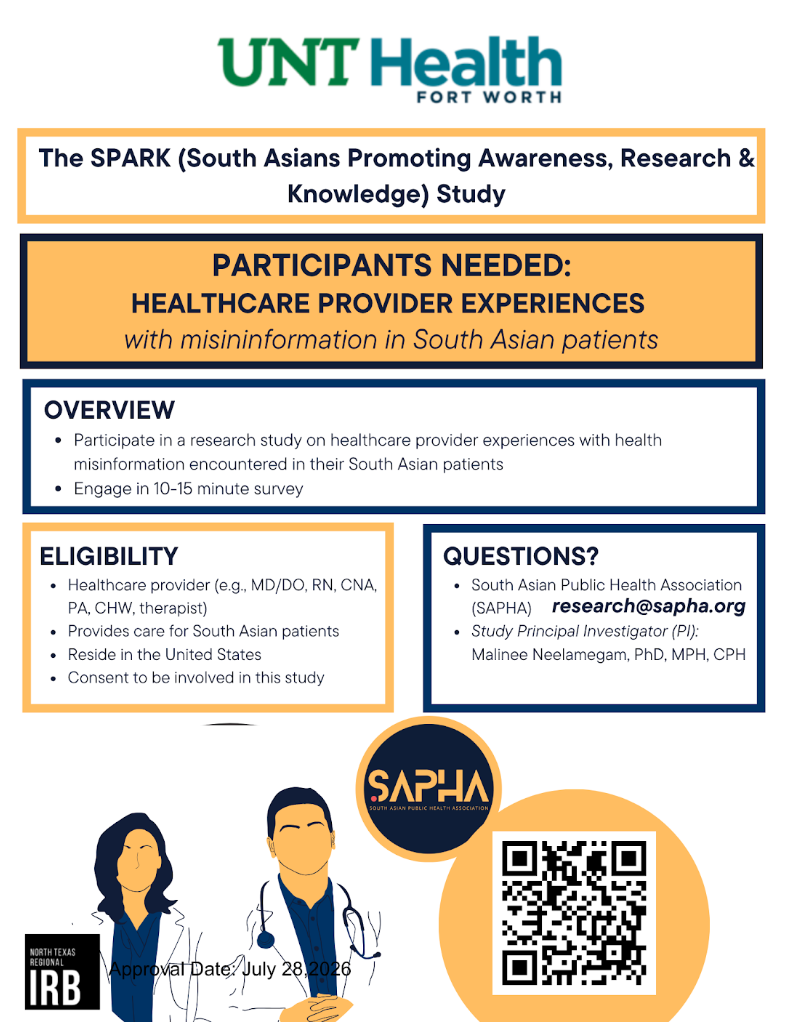
Research Study Recruitment: Project SPARK
SAPHA is pleased to launch a new research project: South Asians Promoting Awareness, Research & Knowledge (SPARK). SPARK aims to assess the current state of health information literacy among South Asian American (SAA) communities, identify common sources and beliefs related to health misinformation, and evaluate the impact of an educational toolkit designed to enhance information literacy.
This research is being conducted by SAPHA in partnership with the UNT Health Fort Worth, with Institutional Review Board approvals for research with South Asian populations. All collected information will be de-identified and your participation is voluntary.
The first part of this project includes a survey for healthcare providers (HCPs) to explore their experiences with health misinformation encountered in their South Asian patients.
To be eligible for the HCP survey, you must:
- Be a healthcare provider (e.g., MD/DO, RN, CNA, PA, CHW, therapist)
- Provide care for South Asian patients
- Currently reside in the United States (US)
- Consent to participation in potential research
Please reference the flyer below for more information and a link to participate.
|
|
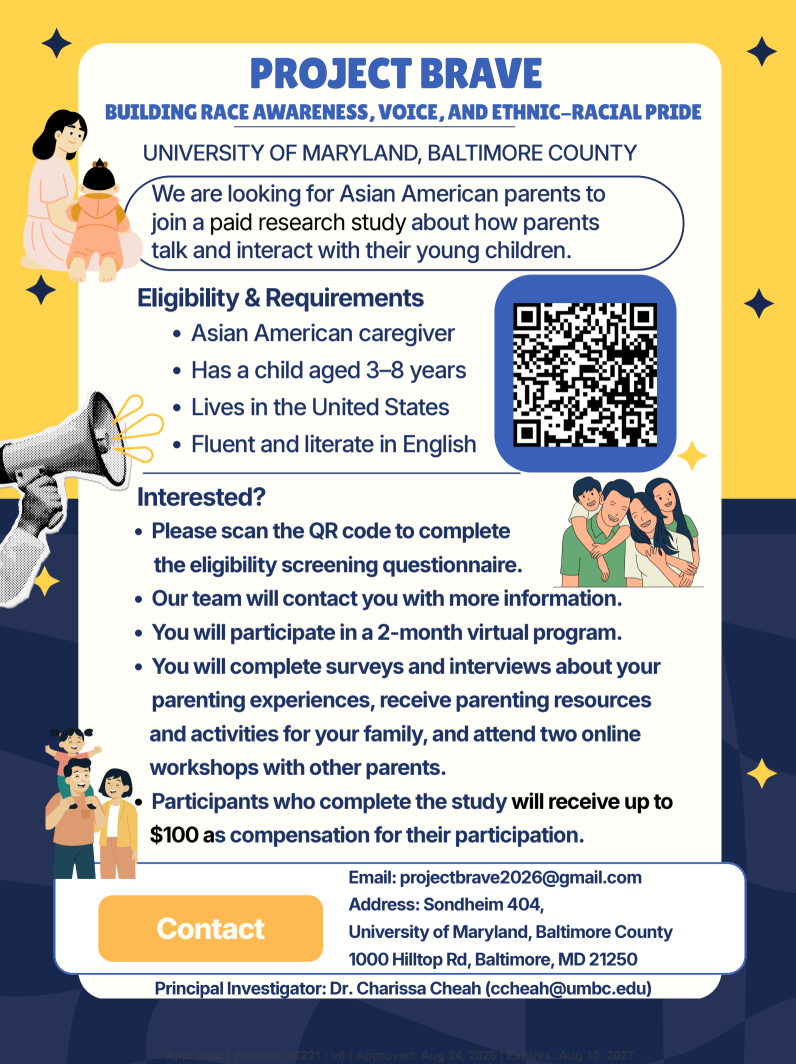
Research Study Recruitment: Project BRAVE
A research team at UMBC is recruiting families for Project BRAVE, a virtual parenting program designed to help Asian American parents have healthy, age-appropriate conversations with children about culture, race, ethnicity, and identity.
Families may be eligible if both parents identify as Asian American and have a child ages 3–8. The two-month program includes virtual workshops and resources, and participating parents can receive up to $100. Interested families should scan the QR code in the attached flyer to complete an eligibility screening survey. If you have any questions, please contact: Projectbrave2026@gmail.com.
|
How You Can Make an Impact Today:
Help us continue raising awareness, sharing resources, and creating space for important conversations about mental health in South Asian communities. Your support helps us build healthier communities.
✅Donate to expand South Asian public health today
|
|
|
Know someone who might enjoy these newsletters?
Ask them to sign up for our email list here.
|
|
|
Follow us on social media for tips, resources, and community health updates
|
|
|
|
|